
Is that your best price?
Beyond the Installation
I’ve had a handful of customers ask me this recently, and it’s got me thinking.
Usually, by this point, we’ve spent some time working through their project together. We’ve discussed what they want to achieve, looked at their property and developed a design around their individual circumstances.
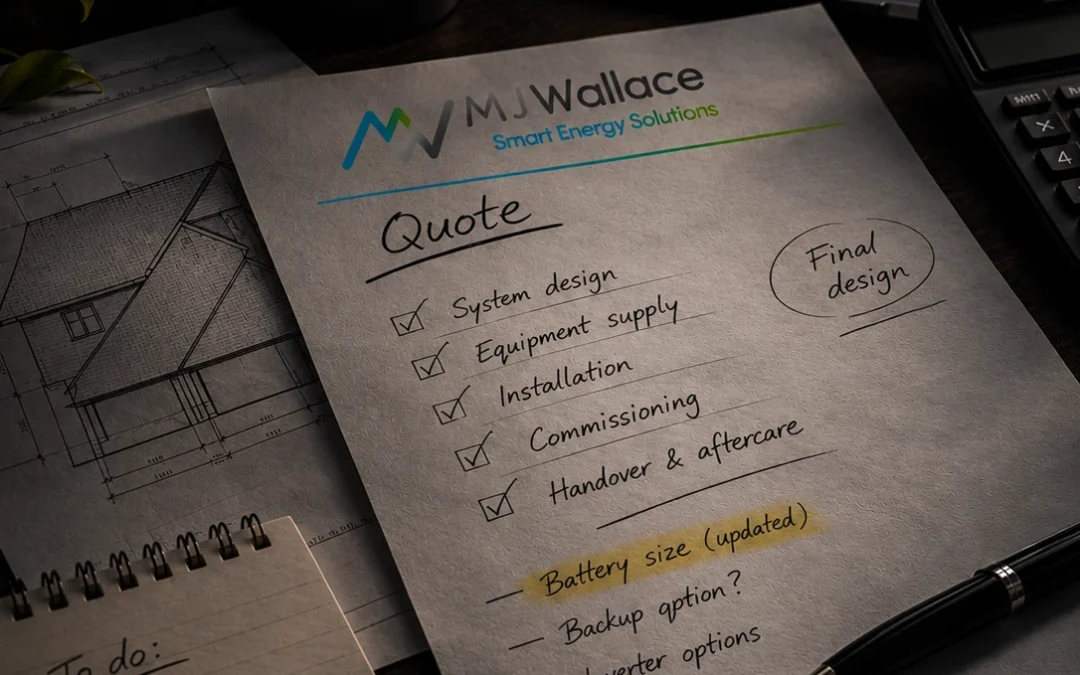
Along the way, things change. We might increase the battery capacity, look at a different inverter or discuss whether they want backup during a power cut. Something gets added, something else comes out, and sometimes an item we removed finds its way back in again.
The price changes with those decisions. It goes up, comes down and gradually settles as we work towards the final design. Eventually, we arrive at something that suits the customer, their property and what they want the system to do.
And then, every so often, comes the question:
“Is that your best price?”
I understand why people ask. This is a significant purchase. Nobody wants to spend thousands of pounds and then discover they could have paid less simply by asking a question.
I’ve even asked it myself when buying things but being on the other side of that conversation has made me think about what we actually expect the answer to be.
The negotiation we seem to expect
My answer is inevitably always, yes, it is our best price.
The customer has seen the figure change as we’ve changed the design. What we’ve arrived at is the amount we need to deliver that particular project properly. We haven’t added a bit at the end in anticipation of being asked to take it off.
But should we have?
Should I put another few hundred pounds on every quotation so that, when someone asks, I can reduce it and everyone feels they’ve achieved something? If that’s how it works, what happens to the customer who doesn’t ask?
Do they pay more for the same installation because they trusted the original figure? Because they don’t enjoy negotiating? Because they assumed that, when I gave them a price, I meant it?
Or am I supposed to remind them?
“Before you accept that, there’s a question you’re meant to ask me.”
It sounds a bit ridiculous written down, but that’s the part I struggle with.
I don’t particularly like the idea of someone’s confidence in negotiating determining how much they pay for our work.
At the same time, I can see why customers feel they need to try. Discounts, sales and special offers are everywhere. If the price can apparently drop the moment you hesitate, accepting the first figure starts to feel a little naïve.
That expectation hasn’t appeared from nowhere. Businesses have helped create it.
What does “best” actually mean?
There’s another question underneath all of this: when we say “best price”, do we actually mean the lowest possible number?
There will always be ways to make a project cheaper.
We can change the equipment, reduce the scope or remove a feature. Sometimes those are sensible decisions. A customer might decide that backup isn’t important enough to justify the additional cost, or that a smaller battery will meet their needs.
That’s a useful conversation, and one I’m happy to have..
There’s a difference between finding a more affordable solution and giving someone the impression that the original price contained money we didn’t really need.
Our starting figure needs to cover the equipment, materials, labour and the time involved in delivering the job. It also needs to contribute towards running the business and leave a profit. Profit is not a dirty word.
I think we should be able to say that openly.
A healthy business needs enough money to pay its people, maintain its equipment, meet its responsibilities and still be there when customers need support.
That doesn’t give any business permission to charge whatever it likes. We still have to be competitive, efficient and able to explain what we’re offering.
A price that only works if everything goes perfectly, nobody needs any help and nothing takes longer than expected isn’t a particularly sound starting point either.
When a guide becomes a target
I regularly see advice in customer groups along the lines of:
“Never pay more than this per kilowatt of solar.”
Or:
“A battery installation should cost no more than that ‘x’ per kilowatt-hour.”
I understand why those figures are popular. If you’re new to solar and batteries, you need some way of judging the quotations in front of you. A rough benchmark gives you somewhere to start.
The difficulty comes when it becomes the figure every installation is expected to meet.
Anything above it can start to feel like a bad deal before anyone has looked at the property or established what the work involves.
A battery fitted close to the incoming supply, with a straightforward cable route, is a different job from one in a detached garage with a long cable run and groundworks.
A solar installation across several awkward roof areas involves different work from the same number of panels on one accessible roof.
Dividing the total by the system size doesn’t explain those differences.
It can also encourage us to judge a design by how much equipment we get for the money. More panels. More storage. A bigger inverter.
Those things may be useful, but capacity only has value if it serves a purpose for that household. Buying more of something doesn’t automatically make it a better purchase.
A benchmark can help you decide what to question. I’d be cautious about letting it answer every question for you.
The same battery doesn’t mean the same installation
Even when two quotes list exactly the same inverter and battery, there can still be differences.
What brand of isolator is being fitted? What consumer unit and protective devices have been allowed for? How are the cables going to be routed, supported and protected?
Will they be clipped neatly along a suitable route, installed in containment or taken underground? What work is included to make that possible?
Have the necessary electrical alterations been identified? Are the applications, testing, certification and handover included? Are there exclusions that could become additional costs?
These details are often less prominent than the photograph of the battery at the top of the proposal.
Some will matter more than others. A different brand name alone doesn’t prove that one installation is better. What matters is whether the equipment is suitable, the design is sound and the work has been properly considered.
And safety and compliance should be the starting point for every installer. They shouldn’t be optional extras reserved for the more expensive quote.
The difficulty for the customer is that much of this work is unfamiliar. They can see two matching batteries and two different totals, but they may not know what else to look for.
That puts a responsibility on us to explain it.
I make these decisions as a customer too
In the previous article about not keeping everything in your head, I touched on the value of our suppliers.
They aren’t always the cheapest but when you realise you haven’t got enough mounting rail and can pick up the phone to someone who helps you sort it out, that service makes a difference.
I could compare the price of each item and choose the lowest figure every time. Sometimes that might be the right decision. Other times, the saving could be outweighed by time spent chasing a delivery, resolving a problem or trying to get technical support.
That doesn’t mean paying more guarantees better service. It means I’ve learned to consider more than the purchase price when deciding who we work with.
It would be a little inconsistent for me to recognise that value when buying for the business, then assume our customers will automatically see it in us.
They need something more useful than “we offer great service”. Every business can write that.
They need clear information, realistic promises and an understanding of what happens if they need help.
What happens when something goes wrong?
I’ve written before about mistakes, including my own.
However carefully you plan, you’re still dealing with people, buildings and equipment. Problems can happen.
What matters then is how they’re handled.
Who answers the query? Who establishes whether it’s a setting, an installation issue or a product fault? Who speaks to the manufacturer, and who keeps the customer informed?
A product warranty is worth understanding, but so is the process of getting a problem resolved.
Someone has to allow time for that work.
Again, this shouldn’t become a vague justification for a higher price. Customers are entitled to ask what support actually means, what is covered and where the limits are.
But the relationship doesn’t necessarily end when the equipment switches on. For a system you expect to use for years, it’s reasonable to consider what happens afterwards as part of the buying decision.
A budget is a useful starting point
There’s also a conversation I think we could make easier: talking honestly about budget.
“This is more than I wanted to spend” tells me something useful.
It gives us an opportunity to revisit the design. Which features matter most? What could be left out? Is there a sensible way to install part of the system now and expand it later?
Sometimes we can find an answer. Sometimes the customer’s requirements and available budget simply won’t meet, and it’s better to establish that clearly.
A customer sharing their budget shouldn’t feel they’ve given us a target to spend up to. They should be able to expect a recommendation based on what they need.
Equally, we shouldn’t keep adding features because they’re technically impressive if they don’t offer enough benefit to that particular customer.
Part of giving good advice is being willing to say, “I don’t think you need that.”
Value includes avoiding spending that serves little purpose.
We have to make the difference understandable
A higher quote doesn’t automatically represent better value.
A lower quote doesn’t automatically mean corners are being cut.
Another installer might have lower overheads, buy equipment at a better price or have a particularly efficient way of delivering that type of job. They may simply be offering a good deal.
We need to be comfortable acknowledging that.
Our running costs are our responsibility to manage. Customers shouldn’t be expected to fund inefficiency, and “we’re a small business” isn’t a complete explanation for a price difference.
If we believe our proposal offers value, we should be able to show where that value sits.
That’s why I like the question:
“Can you help me understand the difference between these quotes?”
It gives us something concrete to discuss. We can look at the equipment, scope, installation arrangements and support, rather than making assumptions based on the final total.
Sometimes the differences will justify spending more. Sometimes they won’t matter enough to the customer.
Either way, they can make a decision with a clearer understanding of what they’re buying.
A price you can take at face value
None of this changes the fact that price matters.
People have mortgages, bills and other priorities. A system can be well designed and fairly priced and still be more than someone can afford. There’s nothing unreasonable about that.
And there’s nothing wrong with asking whether a price can be improved.
What these recent conversations have made me think about is how much confidence sits behind that simple question.
Customers want to know they’re being treated fairly. They want to understand what they’re paying for, and they don’t want to feel foolish for trusting the person giving them a quotation.
That seems a reasonable expectation to me.
I want us to arrive at a price through a clear discussion about the work, the choices and the customer’s circumstances. If the design changes, the price should reflect it. If something is unclear, we should explain it.
And when someone asks, “Is that your best price?”, I want to be able to say yes without wondering whether I should have started higher.
I want the customer who asks and the customer who doesn’t to know they’ve both been treated fairly.
Because trust starts before the installation.
It starts with what we say we’ll do, what we say it will cost, and whether those words mean what they appear to mean.